A First-Time Guide to Yacht Charter in Türkiye
By Maréa Yachts · Reviewed 15 July 2026
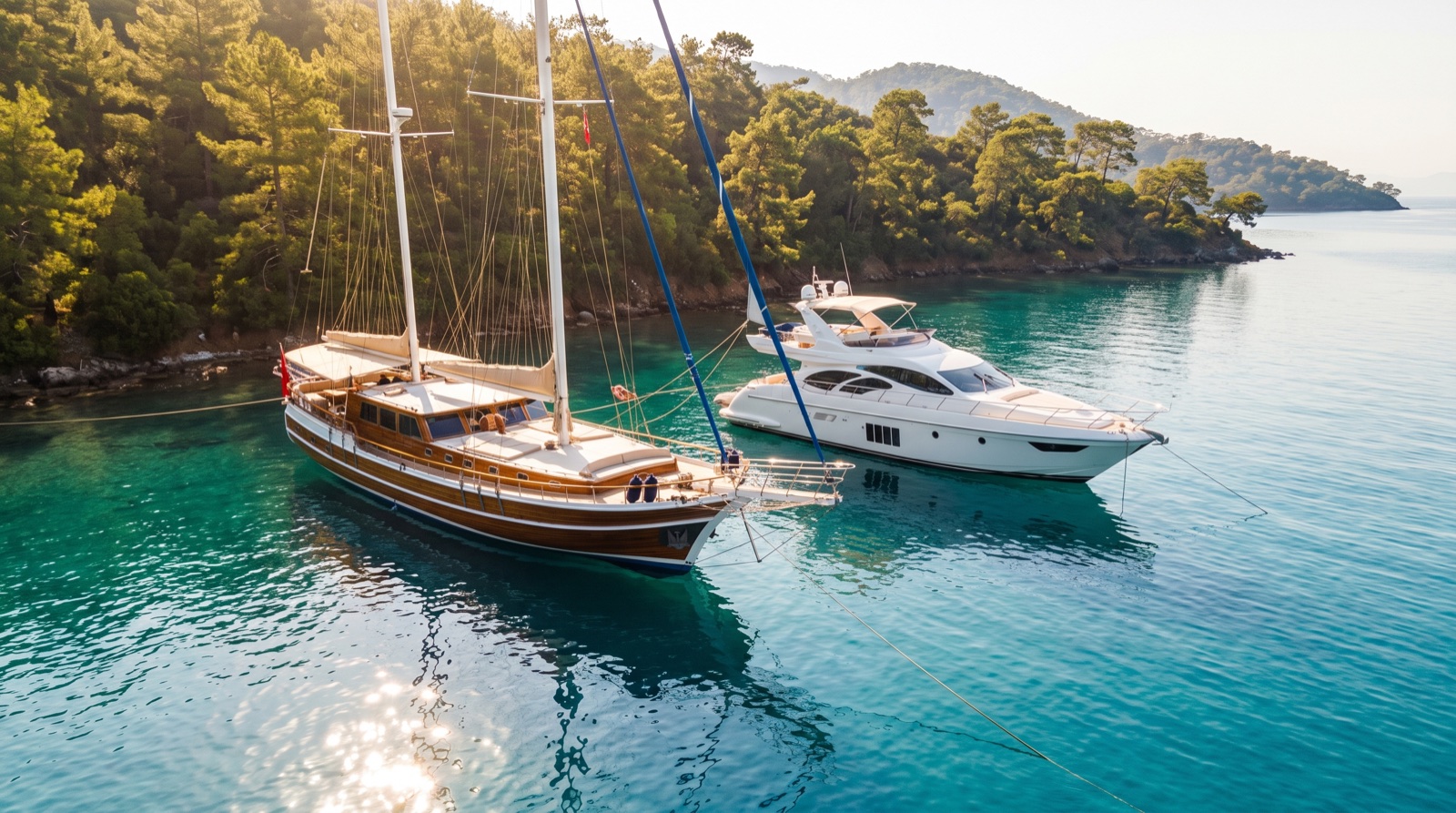
A crewed yacht charter means you take a private yacht and its professional crew for an agreed period — usually a week — and cruise an itinerary shaped around you. You are a guest, not a skipper: no sailing experience is needed. Pricing is normally a weekly base fee plus a separate fund for running costs, taxes where applicable, and a customary gratuity.
What a crewed charter actually is
The simplest way to picture it: you are renting a yacht and the people who run it. The captain, and depending on the yacht a chef, deckhand, stewardess or engineer, come with the boat. They navigate, cook, look after the yacht, handle the anchoring and the marina paperwork, and adapt the plan to the weather and to what you feel like doing. Your job is to say roughly what you want from the week and then enjoy it.
The alternative is a bareboat charter — you take the yacht without crew and skipper it yourself, which requires the qualifications and experience the operator and local rules ask for. Everything below assumes a crewed charter, which is what most first-timers choose.
How the pricing is structured
Charter pricing looks unfamiliar at first because it is not a single all-in number. It usually breaks down like this:
- Base charter fee — quoted per week for the yacht and its crew.
- APA — an Advance Provisioning Allowance, a working fund the captain spends on fuel, food, drinks and berthing, accounted for and reconciled at the end. See our guide to APA.
- VAT and local taxes — applicable in some cases and not others, depending on the yacht, its flag and the itinerary.
- Crew gratuity — customary, discretionary, and entirely at your discretion based on the service.
Figures vary widely by yacht, size, age and season, so we do not quote a range here; our cost guide explains what moves the number and what to ask.
What to decide before you enquire
You do not need a finished plan, but a handful of answers make it possible to shortlist yachts properly rather than send you a catalogue:
- Your dates, and how flexible they are
- How many guests, and how many cabins that realistically needs — couples, singles and children change the arithmetic
- Where you would like to start (or the airport you are flying into)
- The type of yacht that appeals
- A budget range you are comfortable with
- Any priorities — a serious chef, water toys, quiet anchorages, a stable ride, children aboard, accessibility
The yacht types you will see in Türkiye
- Motor yacht — fastest between bays and generally the most space and air-conditioned comfort; also the thirstiest on fuel.
- Sailing yacht — quieter and more atmospheric under sail, though passages take longer and depend on the wind.
- Catamaran — stable, shallow-draft and sociable, with wide deck space; the trade-off is a different, less traditional feel below.
- Gulet — the classic Turkish wooden motorsailer, unhurried and characterful, with a broad range in standard from simple to genuinely luxurious. Judge each one individually.
Where charters start
The main embarkation regions are Bodrum, Göcek, Marmaris, Fethiye and Antalya. Each opens onto a different stretch of coast and a different rhythm of bays, and the choice is often driven as much by flights as by cruising. Our destinations guide sets out what each area is like.
Season and timing
The charter season broadly runs from late spring to early autumn. The shoulder months at either end are often calmer and less crowded, while July and August are the busiest and warmest. Popular yachts and peak weeks tend to be committed early — sometimes a season ahead — so if your dates are fixed, enquiring sooner simply gives you more to choose from. Late availability does exist, but it chooses you rather than the other way round.
What a day aboard looks like
There is no timetable, but a typical day settles into a shape: breakfast at anchor, a swim before the sun is high, a slow morning, lunch aboard while the yacht moves a bay or two, an afternoon in the water or ashore, then dinner — either cooked by the crew or in a village harbour. Most of a good charter is spent at anchor rather than under way. If you want to cover distance, say so early; if you want to see three bays all week, that is equally valid.
What to bring
Less than you think, and in soft luggage — hard suitcases are difficult to stow aboard. Swimwear, light layers for the evening, sun protection, a hat, soft-soled or bare feet for the deck, and any medication you need. Space is finite and laundry is often possible; a formal wardrobe rarely is.
The paperwork
Straightforward in practice. Expect to provide passport details and a guest list ahead of embarkation for the yacht's clearance, sign a charter agreement, and fill in a preference sheet — a questionnaire covering food, drinks, allergies, and how you like to spend a day. Take the preference sheet seriously; it is what the chef and captain plan your week around.
Crossing to the Greek islands
It is a common question and the honest answer is that it depends. Whether a yacht can cross depends on its flag, its permissions and the regulations in force at the time, and these change. Some yachts arrange crossings routinely; others cannot. Treat it as something to confirm for a specific yacht before you book, never as a given.
Do I need any sailing experience to charter a yacht?
Not for a crewed charter. The yacht comes with its own professional crew, and you are a guest aboard. Experience is only relevant for a bareboat charter, where you skipper the yacht yourself and must hold the qualifications the operator and local rules require.
How far in advance should I book?
There is no fixed rule, but popular yachts and peak summer weeks tend to be reserved well ahead, often many months in advance. Shoulder-season dates and late availability do appear. The earlier you enquire, the wider the choice of yachts.
What is included in the charter price?
Typically the base fee covers the yacht, its crew, insurance and the use of equipment aboard. Variable running costs such as fuel, provisions and berthing are usually funded separately through an APA, with taxes and a customary crew gratuity on top. What is included varies by yacht, so confirm the terms for the specific yacht.
Can we cross to the Greek islands?
It depends on the yacht's flag, its permissions and the regulations in force at the time. Some yachts can arrange a crossing with the correct clearance; others are restricted to Turkish waters. Ask about it before booking rather than assuming it is possible.
Related reading: Yacht charter in Türkiye · What is included in a crewed charter? · How much does a charter cost in Türkiye?