The Early Stages of a New Yacht Build
By Maréa Yachts · Reviewed 15 July 2026
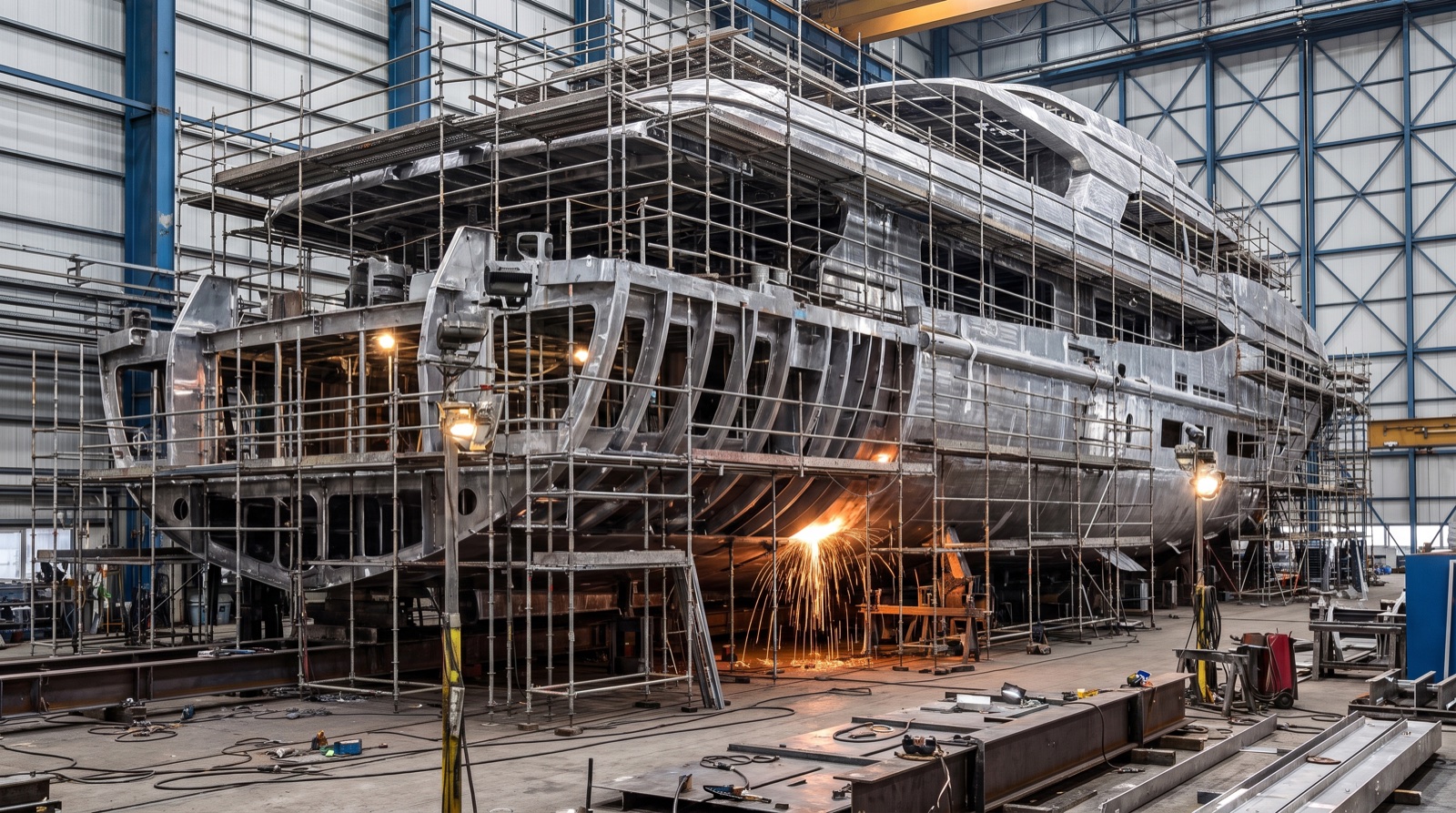
A new yacht build begins long before steel is cut. The early sequence runs from a written owner's brief, through feasibility and budget testing, to a design team producing a concept, a general arrangement and a preliminary specification — and only then to shipyard selection and contract. Almost every cost overrun and disappointment traces back to decisions taken, or skipped, in this phase.
It starts with a brief, not a drawing
The temptation is to begin with images: a profile you admire, a beach club you saw. A better starting point is a written brief that answers plain questions. How will the yacht actually be used — long passages, or short hops between familiar anchorages? How many guests, how often, and who are they? How many crew does that imply, and where will they live and work? What range and speed do you genuinely need, not the ones that sound reassuring? Which regions and seasons? What style, described in words before it is drawn?
The brief is worth writing down because it becomes the test every later decision is measured against. When a designer proposes a change, the question is not whether it is beautiful but whether it still serves the brief.
Feasibility and a budget reality-check
The next step is unglamorous and valuable: testing whether the brief is buildable within the budget you have in mind. Volume, range, guest count and crew requirements pull against one another, and briefs are frequently found to describe a larger, more expensive yacht than the owner intended. Costs vary widely by size, complexity, shipyard and specification, so figures should be developed for your specific project rather than borrowed from another. It is far cheaper to discover a mismatch here than after a contract is signed.
The design team, and who does what
Two distinct roles are often blurred. The naval architect is responsible for the engineering: hull form, structure, weight and stability, machinery and systems, and compliance with the rules the yacht must satisfy. The exterior designer shapes the profile and lines; the interior designer shapes the spaces, materials and how the yacht feels to live in. All three work to the same layout, and in practice the naval architect's constraints set the boundaries within which the designers can move. Understanding this early prevents the familiar cycle of falling in love with a rendering that engineering later has to unpick.
Concept, general arrangement, specification
Design then proceeds in a recognisable order. A concept establishes the character and rough dimensions. The general arrangement — the GA — is the deck-by-deck layout showing where everything sits: guest cabins, crew areas, machinery spaces, tenders, stowage. It is the single most consequential drawing in the project, because nearly everything else is derived from it.
Alongside it comes the preliminary specification: a written description of the yacht's systems, materials, equipment and standards. It is undramatic reading, and it is the backbone of the contract. Together with the GA, it defines what the shipyard has agreed to deliver. Anything not written into it is left to interpretation, and disagreements during construction are settled by reading the specification, not by recalling what was said in a meeting.
Class and flag, chosen early
Classification society and flag state are not administrative afterthoughts. They drive structural rules, safety systems, crew accommodation standards and manning levels — decisions that reach directly into the design. Choosing them late, or changing them after the design has developed, can force redesign and rework. Requirements vary by vessel type, size and jurisdiction, and should be confirmed with the classification society and flag administration for your specific project.
Choosing the shipyard
With a GA and specification in hand you can approach shipyards and compare like with like. That comparison is the point: a quotation without a common specification behind it is not comparable to anything. Look beyond headline price at what is included and excluded, how the yard has handled work of similar type and complexity, its current workload, and how it communicates when questioned. Visit. Ask to see work in progress. The relationship will run for years.
Contract and payment milestones
The contract should tie payments to verifiable physical progress — steel cutting, keel laying, launch, sea trials, delivery — rather than to the calendar alone. It should also set out how changes are handled, what happens if the yard is late, and what protection exists for money already paid. This is where independent legal advice earns its cost.
Independent oversight
An owner's representative or project manager watches the build on your behalf: reviewing drawings, attending the yard, checking that what is being built matches what was specified, and raising issues while they are still cheap to fix. The value is in the independence. Someone whose only interest is your interest will ask questions that no one else in the room is incentivised to ask.
Once construction starts: drawings and approvals
Building settles into a rhythm of detailed drawings issued for owner review and approval, with defined windows to respond. It is a genuine obligation. Slow approvals delay the yard, and delays cost money. Establish early who reviews what, and how quickly.
Expect it to take time, and to iterate
Serious projects are long, and the pre-contract phase deliberately so. Iteration is not a sign that something is going wrong — it is the process working. Durations vary too much by project to be usefully generalised; what is consistent is that time invested before contract tends to reduce cost and delay afterwards.
The biggest early mistake
Rushing the brief, and then changing the GA late. Every layout change after the design is frozen ripples outward — structure, systems, weight, schedule — and arrives as a change order. Change orders are expensive, and they compound. The discipline of resolving the layout while it is still only lines on paper is the single most effective cost control available to an owner.
How does a superyacht build actually start?
With a written brief describing how the yacht will be used, then a feasibility and budget check. A design team follows with a concept, a general arrangement and a preliminary specification. Steel is cut long after those decisions are settled.
What is the difference between a naval architect and a yacht designer?
The naval architect owns the engineering — hull, structure, stability, systems, compliance. The exterior and interior designers shape how the yacht looks and feels. Both work to the same GA, and the naval architect's constraints usually govern where the designers can move.
Why does the specification document matter so much?
Because with the GA it defines what the yard has agreed to deliver. Anything not written into it is open to interpretation, and disputes are resolved by reading the specification rather than by recalling conversations.
Why should class and flag be chosen early?
They drive structure, safety systems, crew accommodation and manning. Changing them after the design develops can force redesign and rework. Requirements vary and should be confirmed with the classification society and flag administration.
Related reading: New yacht build in Türkiye · How to select a shipyard in Türkiye