Türkiye's Main Yacht Building & Refit Regions
By Maréa Yachts · Reviewed 15 July 2026
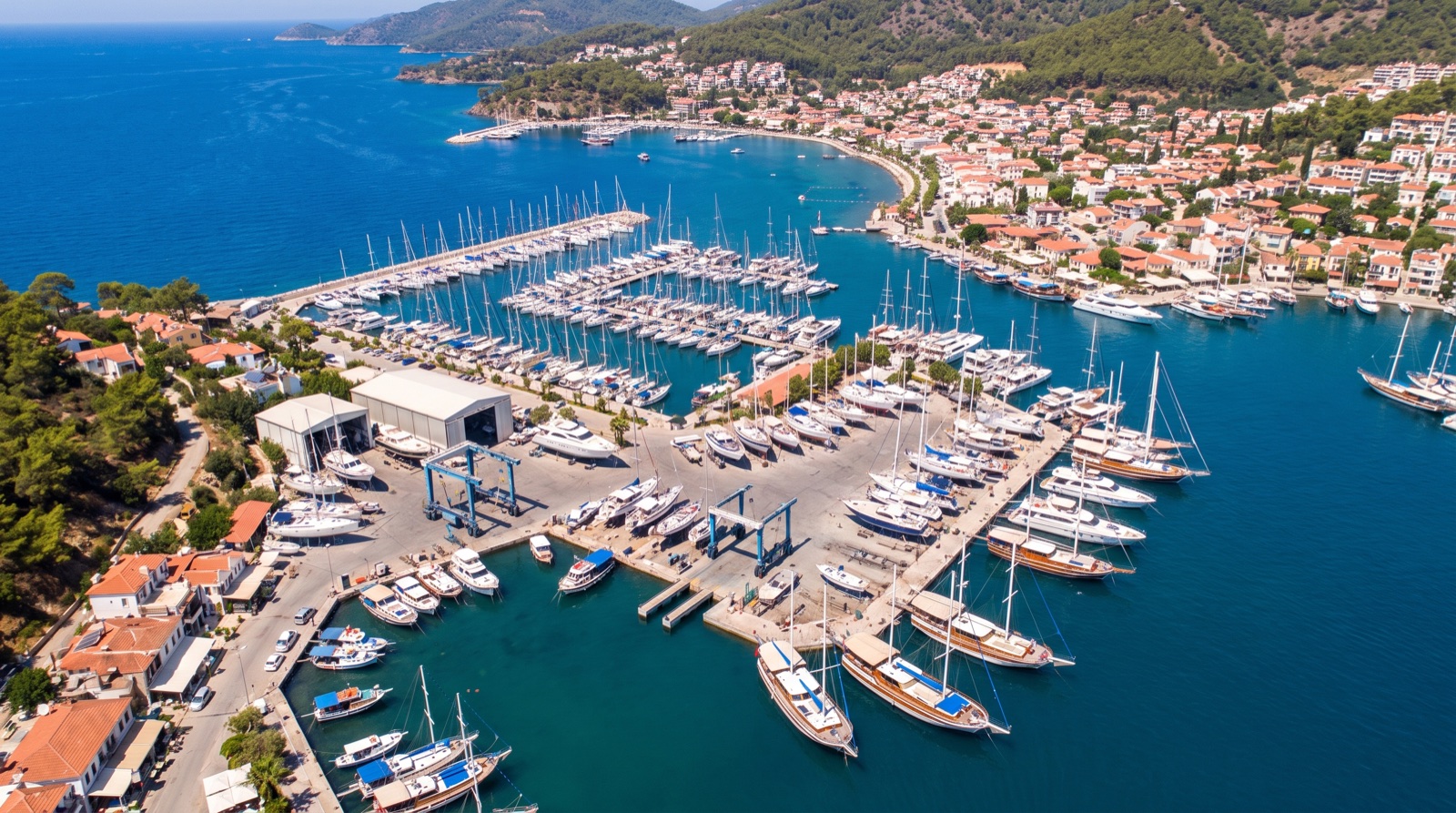
Yacht building and refit work in Türkiye is concentrated in a handful of coastal clusters: Tuzla near Istanbul, the Antalya Free Zone on the Mediterranean coast, Bodrum and the Aegean, the charter-and-service belt around Marmaris, Göcek and Fethiye, and the newer Yalova / Altınova cluster. Each region has a different mix of materials, sizes and facilities it handles well. The right one depends on your yacht's size and construction, the scope of work, and where you and your captain want to be while it happens.
Why Türkiye at all
Türkiye is a serious yacht building and refit country for reasons that are structural rather than promotional. It has a long shipbuilding tradition and an even longer wooden boatbuilding one, which left behind a deep pool of skilled hands — particularly in joinery, where a yacht's interior is largely won or lost. Around the yards sits an established chain of local suppliers, fabricators, upholsterers and specialist subcontractors, so work does not have to be flown in. And the coastline itself helps: the yards sit beside the Aegean and Mediterranean cruising grounds where the yachts will actually be used, which matters both for sea trials and for the winter refit cycle.
None of that means every yard is equally capable. Capability in Türkiye varies enormously between neighbours in the same yard basin. The regions below describe where the industry is, not a guarantee of what any given yard within them can do.
Tuzla and Istanbul (Marmara)
Tuzla, on the Asian side of Istanbul, is Türkiye's long-established shipbuilding cluster — a working industrial coastline of yards, docks and workshops rather than a marina district. Its strengths follow from that: steel and aluminium construction, heavy fabrication, and immediate proximity to the industrial supply chain, engineering firms and class surveyors of a city of that size. If a project needs metal hull work, serious engineering, or contractors who are half an hour away rather than half a day, Tuzla's density is the argument. The trade-off is that it is far from the southern cruising grounds and is not somewhere an owner spends a pleasant week overseeing work.
Antalya Free Zone
The Antalya Free Zone is a purpose-built industrial zone on the Mediterranean coast where a meaningful part of Türkiye's larger yacht construction takes place. Two things distinguish it: it was laid out for manufacturing, so it has the sheds, quays and lifting infrastructure that come with that; and it carries free-zone customs status, which can simplify bringing in imported materials and equipment and exporting the finished yacht. That matters most for export-oriented builds where an owner never intends to import the yacht into Türkiye at all. Free-zone rules, eligibility and treatment do change, and they interact with a yacht's flag and intended use — confirm the current position for your specific project rather than assuming.
Bodrum and the Aegean
Bodrum is the heart of Türkiye's traditional boatbuilding heritage. The gulet is the visible product of it, but the more useful legacy is the craft base: generations of shipwrights, joiners and finishers, and a culture in which handwork on wood is normal rather than exotic. That skill has migrated. The Aegean now handles composite construction and a great deal of refit and interior work, and the joinery tradition is exactly why owners bring interior and finishing projects here. Bodrum is also pleasant to be in, which is not a trivial factor when someone has to visit a yard repeatedly over months.
Marmaris, Göcek and Fethiye
This stretch of the south-west coast is charter and service country. Its yards and marinas are geared to maintenance, refit, guarantee work and winter storage for the very large fleet that cruises and charters here. The capability is real but different in character from Tuzla or Antalya: haul-out, paint, systems work, rigging and seasonal overhaul rather than building hulls from scratch. For an owner whose yacht is already in the region, the logic of refitting where the yacht already lives — no delivery passage, no crew relocation — is often decisive.
Yalova and Altınova
Yalova, and specifically the Altınova area across the water from Istanbul, is a newer and growing yacht building and marina cluster. It offers something close to Tuzla's proximity to the Istanbul supply chain in a setting laid out more deliberately for yachts, with modern marina and yard facilities. It is worth knowing about precisely because it is less established in most owners' mental map of Türkiye than Tuzla or Antalya.
What actually drives the choice
- Material and size capability. Steel and aluminium, composite and wood are different trades. A yard fluent in one may be merely adequate at another, and length overall quickly narrows the field.
- Haul-out and covered sheds. Travel-lift capacity is a hard limit — if the lift cannot take the yacht, the conversation ends. Covered, climate-controlled sheds matter enormously for paint and finishing work.
- Proximity to owner and captain. Projects that are visited go better than projects that are not. Distance quietly determines how much oversight actually happens.
- Logistics and supplier chain. How fast a specialist subcontractor or a replacement part can reach the yard shapes the schedule more than most owners expect.
- Proximity to cruising grounds. A delivery passage costs time, fuel and crew. Refitting near where the yacht is used removes it.
- Seasonality. Refit work concentrates in winter, when the fleet is laid up. Shed space and good contractors are competed for in that window and should be booked well ahead.
- Customs and free-zone status. For export-oriented builds this can be a genuine factor, but it is technical, project-specific and changeable.
A note on how to use this
Region is a filter, not an answer. It narrows a long list to a plausible shortlist — and then the real work begins at the level of the individual yard: what it has actually delivered, who is running the project, how the contract handles change orders and delay, and whether the shed you were shown will still be free when your yacht arrives.
Where are yachts built in Türkiye?
Mainly in Tuzla near Istanbul, the Antalya Free Zone, Bodrum and the wider Aegean, and the growing Yalova / Altınova cluster. Marmaris, Göcek and Fethiye are more service- and refit-oriented than build-oriented.
Which region is best for a refit?
There is no single best region — refit work happens across Tuzla, Antalya, Bodrum, Marmaris, Göcek and Fethiye. It depends on the yacht's size and material, the haul-out and covered-shed capacity available, the scope of work, and how convenient the location is for the owner, captain and any specialist contractors.
What is the advantage of the Antalya Free Zone?
It is a purpose-built industrial zone with free-zone customs treatment, which can simplify importing materials and equipment and exporting a finished yacht. The rules and eligibility change over time and should be confirmed for the specific project.
Why is Türkiye a serious yacht building country?
A long shipbuilding and wooden boatbuilding tradition, a deep pool of skilled joinery and metalwork labour, an established local supplier chain, and a coastline beside busy cruising grounds. Capability still varies widely from yard to yard.
Related reading: New yacht build in Türkiye · Yacht refit in Türkiye · How to select a shipyard in Türkiye